Turning an Underused Corridor into a Vibrant Advertising Space
In 2021, Astral Media Affichage, a long-time client of Media Graph, faced a unique challenge in downtown Montreal. The company needed to activate a long, dimly lit underground pedestrian corridor at 1000 De La Gauchetière, a high-traffic yet visually neglected space. The goal was to transform this area into a premium advertising environment that could showcase large-scale campaigns for both property promotions and future advertisers.
However, the environment posed logistical and architectural constraints that made conventional installation methods nearly impossible. This case study explores how Media Graph overcame these challenges with Modular SEG (Silicone Edge Graphic) large-format lightboxes, powered by TLS Architectural Lighting technology.
A Vision for Premium Urban Advertising
Astral Media Affichage, a leader in out-of-home advertising, sought to enhance the visibility and appeal of its downtown Montreal property portfolio. Their initial concept involved massive, illuminated displays stretching up to 60 feet wide and 12 feet high an ambitious idea designed to dominate the corridor visually.
Yet, while bold, the design faced practical concerns around transportation, installation, maintenance, and long-term cost. To realize the vision without compromising practicality, Astral turned to Media Graph for a more efficient, scalable, and visually consistent solution.
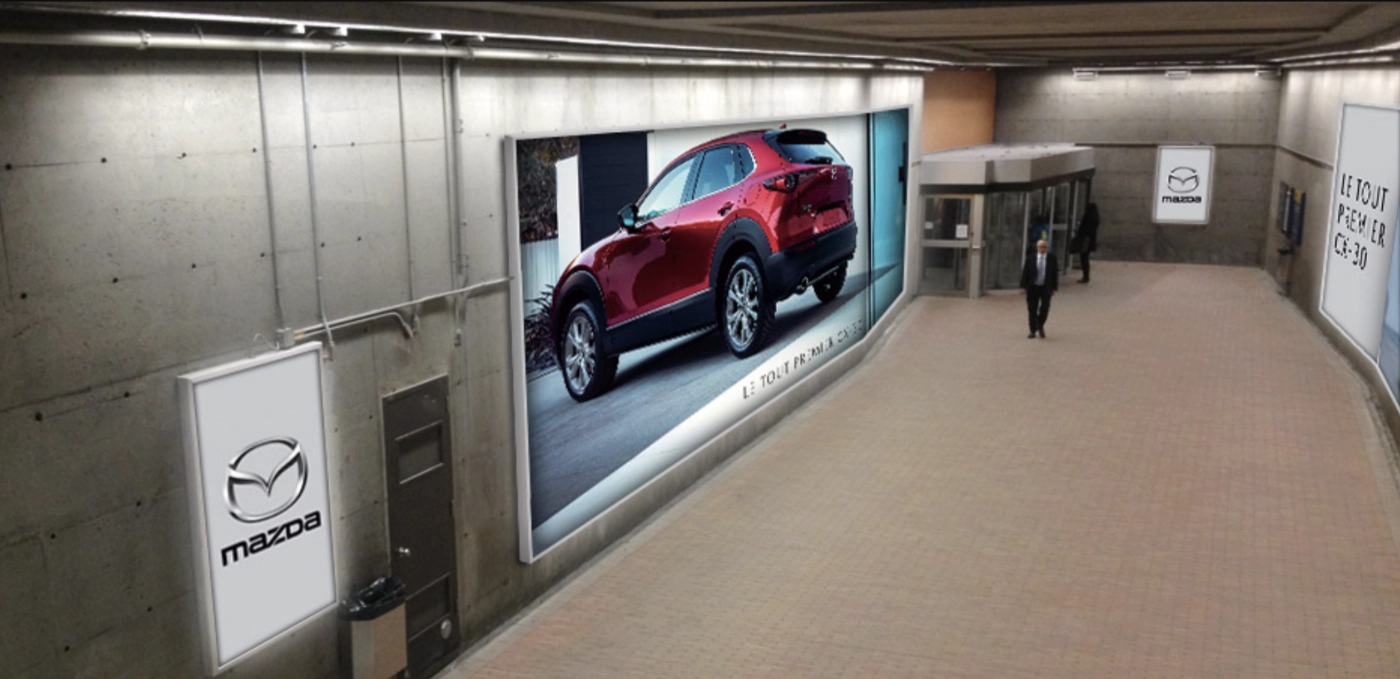
The Challenge: Access, Scale, and Performance Constraints
The 1000 De La Gauchetière corridor presented multiple constraints that made traditional advertising systems unfeasible:
1. Restricted Access and Installation
The underground corridor featured narrow stairways, angled walls, and low ceilings. Bringing
in large lifts or pre-assembled 12-foot-tall structures was impossible.
2. Oversized Original Concept
The original single-piece graphic design posed significant transport and maintenance
risks.
Any damage or vandalism would require replacing the entire massive panel — driving up costs
and downtime.
3. Performance Expectations
Astral required uniform brightness, color consistency, and durability suitable for a
high-traffic public space. The lighting system needed to perform reliably while remaining
energy efficient over long operating hours.
Media Graph’s challenge was clear: deliver a high-impact illuminated environment that met architectural constraints without sacrificing visual excellence
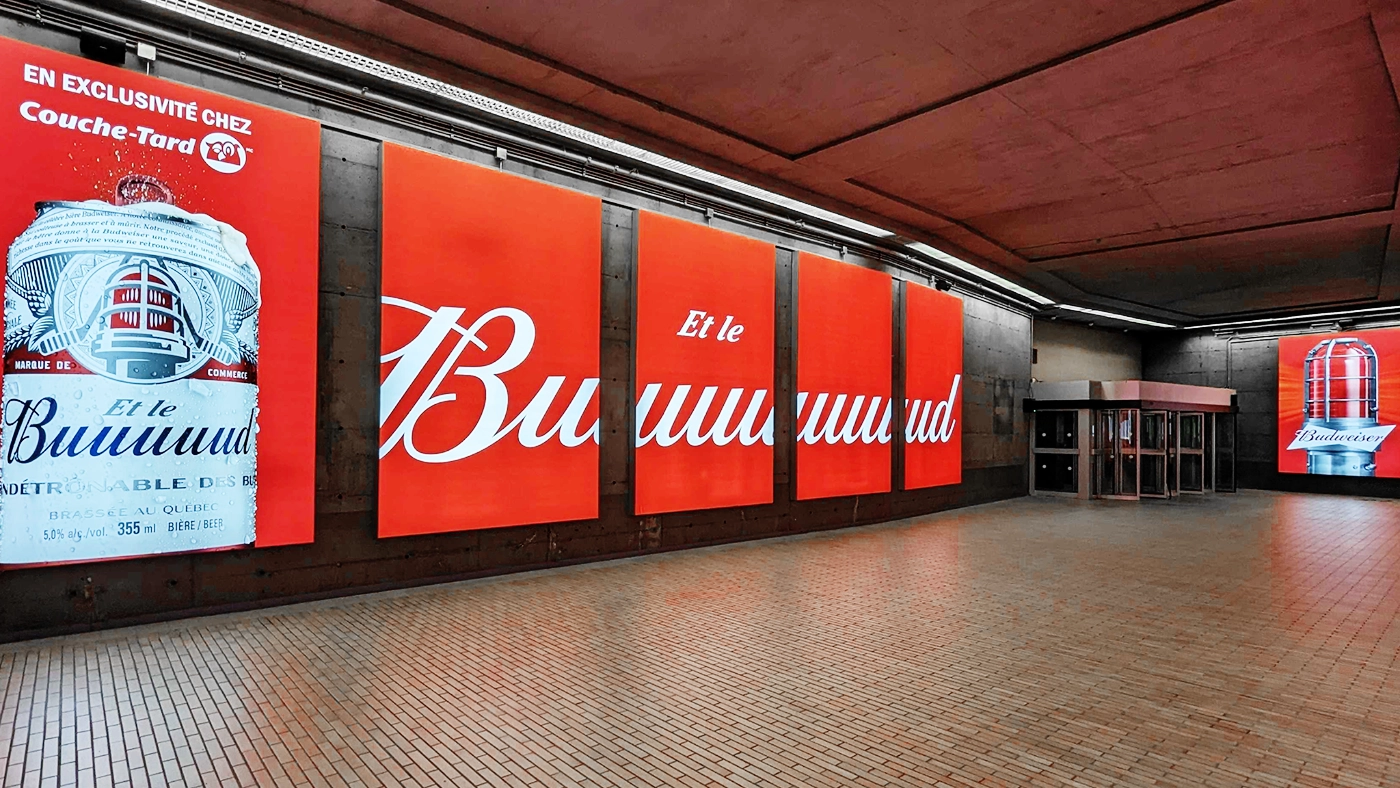
The Solution: Modular SEG lightbox system
Media Graph engineered a modular large-format lightbox system that redefined how large, illuminated displays can be installed in complex environments.
Modular Engineering for Maximum Flexibility
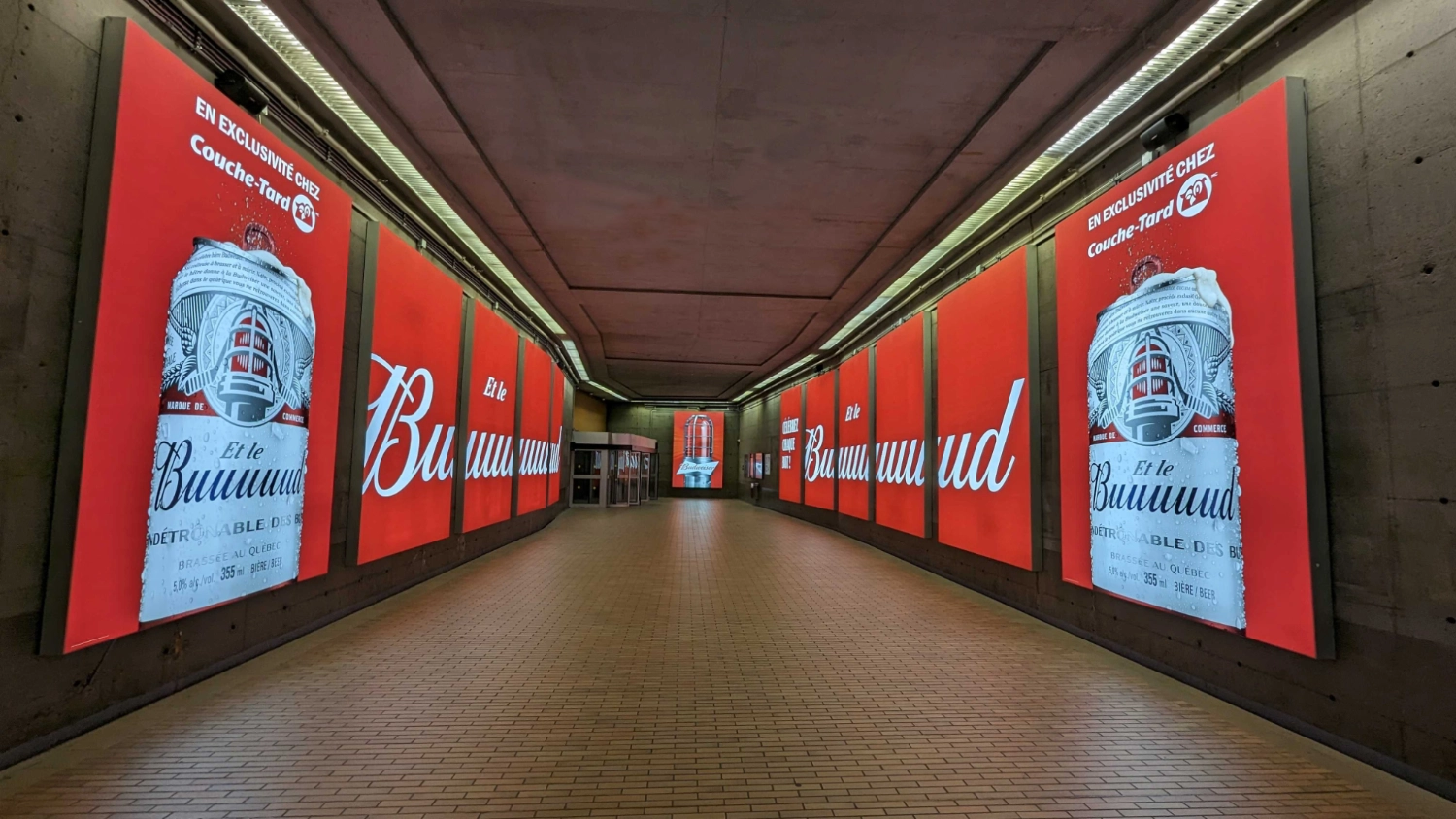
Instead of one oversized frame, the wall was activated using 12 individual lightboxes, each measuring 96 in × 144 in. This modular approach:
- Simplified transport through narrow corridors
- Enabled independent installation and servicing
- Maintained seamless visual continuity across all displays
Split-Frame Construction
Each lightbox frame was designed in two vertical sections for easy handling through tight
access points.
The clear anodized aluminum profile
ensured durability, stability, and a sleek architectural finish.
Advanced LED Lighting System
Media Graph selected the TLS Architectural Lighting Astra Opto Lighting Engine, offering:
- Color Temperature: 6500K
- Brightness Output: 47,532 lumens per unit
- Energy Efficiency: 110 lm/W
- Power Consumption: 432W per unit
Smart Electrical Integration
Each lightbox was equipped with:
- 2 × HVG-320-24A integrated drivers
- Single junction box per unit
- 115V AC input with 8 ft cable (top-center-back exit)
Installation Approach: Turnkey Design and Execution
Media Graph handled the project end-to-end, from structural engineering and LED integration to printing and final installation.
Using surface-mounted WB13 brackets, each unit was installed with precision alignment. A silicone perimeter gasket was added to prevent light leakage, ensuring a clean, professional finish.
Notably, the entire installation was completed without the use of heavy lifting equipment, demonstrating the logistical and engineering advantages of modular design.
A Visually Transformed Space
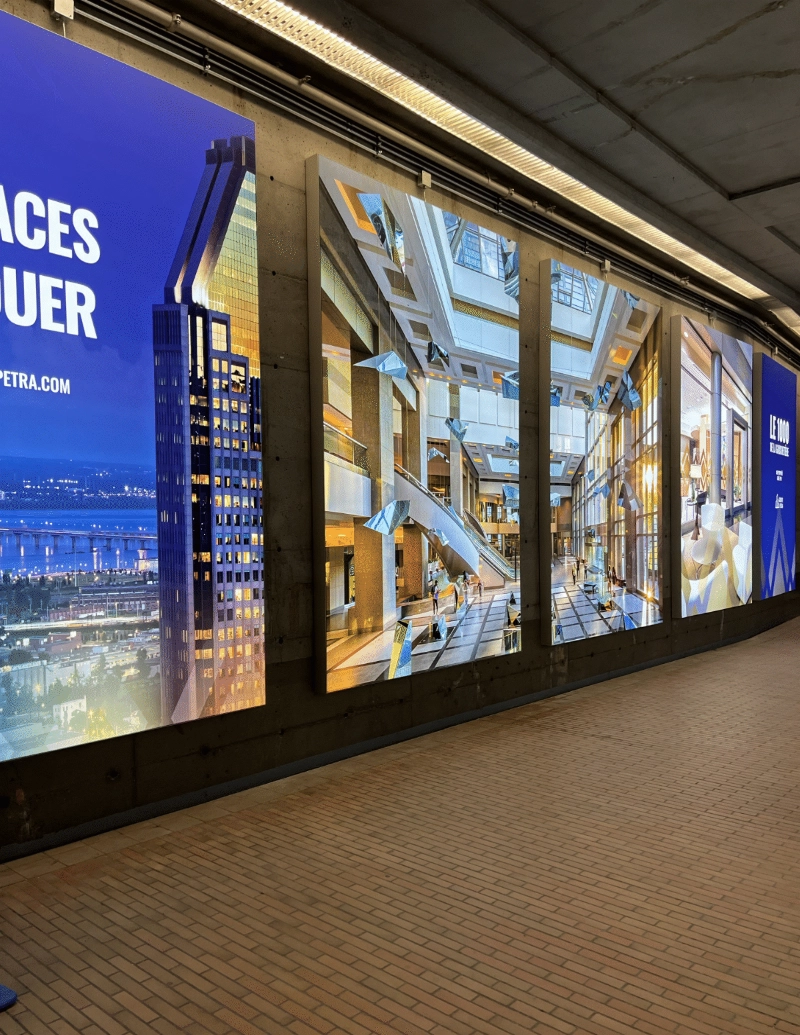
The results exceeded expectations:
• 12 high-impact illuminated displays installed in a previously challenging corridor.
• Significant cost savings compared to single ultra-wide panels.
• Improved maintenance efficiency — each unit can be replaced independently.
• Uniform brightness and visual consistency across all panels.
• Quick, risk-free installation in a restricted-access environment.
The corridor, once dark and underutilized, became a dynamic and premium advertising
environment, now used for long-term property branding and third-party
campaigns.
Business Impact: Innovation that Drives Visibility
The success of this project underscored Media Graph’s expertise in merging print, lighting, and structural design into one seamless process.
This modular solution not only delivered operational efficiency and visual impact but also created a sustainable platform for ongoing advertising use — adaptable to new graphics, brands, and campaigns with minimal disruption.
“This was a turnkey project, printing, lighting, and fabrication working together. The result was effortless for the client and highly impactful for the space.”
Why Modular Large-Format Lightboxes Matter
For spaces like underground corridors, retail environments, or transit hubs, modular lightboxes offer numerous advantages:
- Easier transportation and installation
- Lower replacement and maintenance costs
- Scalable coverage for large walls
- Energy-efficient LED technology
- Design flexibility for evolving campaigns
Visit Our Lightbox Solutions
Conclusion: A Blueprint for Smart Design
The 1000 De La Gauchetière project demonstrates how modular engineering and integrated lighting design can transform even the most challenging architectural environments.
By combining creativity with technical expertise, Media Graph delivered a cost-efficient, durable, and visually stunning solution — proving that innovation truly shines underground.
Frequently Asked Questions (FAQs)
1. What are modular large-format lightboxes?
They are illuminated display systems made from smaller, interlocking sections that combine to form large, continuous visuals. This modular design simplifies transport and installation.
2. Why was a modular approach essential for this project?
Due to tight corridor access, large single-piece frames couldn’t be installed. The modular system allowed easy assembly on-site without heavy machinery.
3. What lighting system was used?
Media Graph used the TLS Astra Opto LED System for its exceptional brightness, efficiency, and color accuracy. For more information visit TLS Architectural lighting.
4. Can these lightboxes be customized for other environments?
Absolutely. Modular lightboxes can be tailored for retail stores, airports, transit systems, and corporate interiors.For more information visit Print & Display.
5. How does Media Graph ensure uniform lighting?
By integrating tension LED systems and optical calibration, ensuring even brightness across every panel.
6. What are the long-term benefits of this modular installation?
Reduced maintenance costs, quick graphic updates, lower risk of damage, and sustainable energy efficiency.